
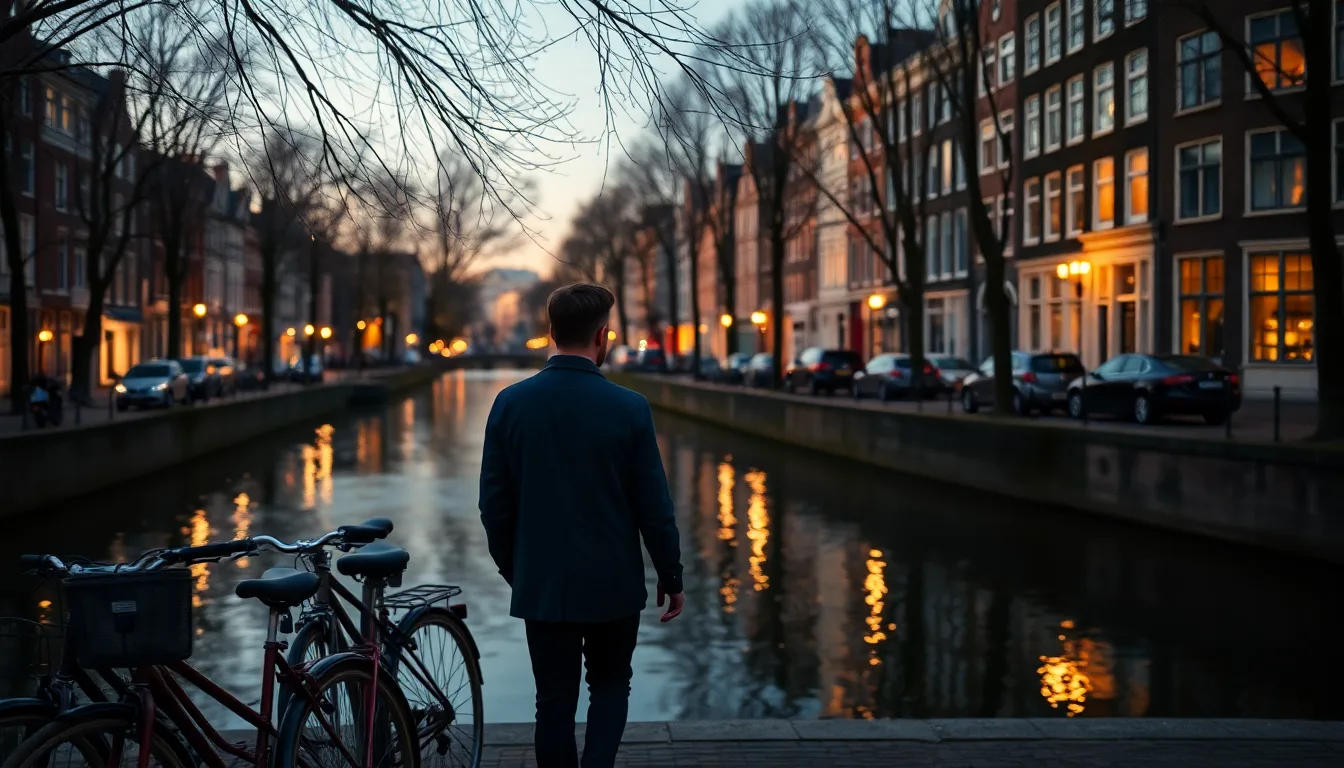
Roughly 48 hours is the average Amsterdam city break: one Friday night, one full Saturday, and a Sunday morning with a train or a flight in it. That is also, by coincidence, the exact amount of time in which most travel romances do their entire arc — meet, accelerate, collapse, cling, part at Centraal Station.
Forty-eight hours is enough to know you like someone. It is not enough to know you love them. Amsterdam, more than almost any other European city, pressures you to confuse those two things, because it is walkable, candlelit, and designed for lingering. Here is how to use the time honestly.
Amsterdam is a conspirator, not a backdrop
A few cities quietly do the work of a good date for you. Amsterdam is near the top of that list. The canals, the gabled fronts, the smell of wet leaves in autumn, the way every bar seems to have existed for three hundred years — all of that is romantic infrastructure that lowers your effort and raises the chance you overshoot.
Knowing this, you can do two things. One, lean into it and let the city carry the first hour so you can focus on the conversation. Two, notice when the feeling is the city talking and not you. If you find yourself thinking about cancelling a flight on Saturday afternoon, it is probably the canal, not the person.
Hour by hour, done well
Friday evening, arrival
Do not schedule a date for the night you land. Your energy is wrong, your hair is wrong, and you have not seen daylight in a country where the sun sets at 4:30 in January. Use Friday evening to get your bearings: a quick dinner at a brown cafe like Cafe de Reiger or Cafe Papeneiland, an early night.
If the match insists on Friday, cap it at drinks. One bar, ninety minutes, no commitments.
Saturday morning
Propose a late breakfast, not coffee. Eleven AM at a cafe in Jordaan or Oud-West. Morning dates in Amsterdam are underused and they work: both of you are rested, the light is good, the stakes are low, and you have accidentally given yourselves the whole day to decide if you want more.
Saturday afternoon
Walk. The city is built for it. Skip the museum if the queue is long; saving two hours of wait is worth more than the Rijksmuseum on a first date. Better options:
- A slow loop through the Nine Streets (De 9 Straatjes), with stops in two bookshops and a vintage store
- A walk along the Prinsengracht, no agenda
- A boat rental from Boaty or Mokum Boot — one hour, cash, bring a thermos
- The Amsterdamse Bos on a clear day, borrowed bikes from the hotel
What you are looking for, besides enjoying the walk: how do they handle directions, mild cold, a plan that falls through, a stranger asking for the time?
Saturday early evening
Pause. This is the most important decision of the date. Around 5 or 6 PM, go back to your respective accommodations. Do not spend twelve straight hours together. Shower, change, text to confirm dinner. This tiny separation does more for the relationship than any of the walking did. It lets the other person become a decision again, not an inertia.
Saturday dinner
Book something in advance. Amsterdam's good restaurants fill up on Saturdays and standing in the cold trying to get a table will puncture the mood. Ideally pick a place with a long, unhurried table culture:
- A small Dutch-Indonesian rijsttafel spot for something different and conversation-friendly
- A natural wine bar like Glou Glou or Worst
- A low-key Italian in De Pijp if you want simplicity
Avoid anywhere that runs two-hour seatings. You want to be able to stay.
Saturday night
One drink after dinner, not three bars. Walk to a jazz cafe or a quiet terrace bar with heaters. The rule for a 48-hour date: if you cannot sit and look at them without needing alcohol to feel comfortable, this is not your person.
Sunday morning
Brunch if the trip allows, goodbye if it doesn't. Sunday is the test: the evening you would romanticise is over, the sheen is off, and you have to see if you still like them in daylight and in a slightly wrinkled shirt.
A travel romance that cannot survive a mildly hungover brunch is a weekend, not a beginning.
The conversations you actually want to have
In 48 hours, some topics are worth making room for, and some you should deliberately avoid.
Worth making room for
- What a normal Tuesday looks like for each of you. Not a dream life, a Tuesday.
- What you are currently annoyed about in your own city. Complaints reveal more than highlights.
- What your last trip was and whether you liked who you were on it.
Deliberately avoid
- Grand declarations. If it is real, it will still be real on a video call in two weeks.
- Aggressive planning of the next shared trip. Let the idea come up naturally on Sunday morning, if it does.
- Ex-partners. Forty-eight hours is not long enough to hear them well.
The goodbye at Centraal Station
Amsterdam goodbyes are iconic because the station is glass, grand, and engineered to feel cinematic. Resist the cinema. A good 48-hour goodbye is short, warm, specific.
Do:
- Say thank you, out loud, for a specific thing from the weekend
- Agree, concretely, when the next check-in happens — a call on Tuesday, a text on Sunday night, whatever you both actually mean
- Let the train leave. Do not dramatise
Do not:
- Say “this weekend changed my life” unless it is, verifiably, Tuesday morning in your home city and it is still true
- Book a return flight before you are home
- Post the photo dump before you have landed
When 48 hours is enough
Sometimes a weekend is the whole thing. You liked each other, you had a good time, you wave at the train. That is a complete story, not a failure. The pressure to convert every travel connection into a long-distance relationship is more a habit than a reflection of what we actually want.
If the weekend is a beginning, it will let you know in week three — the week when both of you are back in your normal routines and still thinking about something specific the other one said. If it is not, it will quietly close, and you will remember the canal light fondly.
When you book your next Amsterdam weekend, try this: plan the Saturday dinner, leave Saturday afternoon empty, and see what the city does with your plans.